LIBERATED SALAD - BIODIVERSITY AT THE TABLE
(when appropriate, please credit Kathy Ging POB 11245 Eugene, OR 541-342-8461 including e-mail address: kathy@kathyging.com)
A one hour a week organic oasis and urban victory for gardener *wanna bees* with no time, a pale green thumb and a littlespace, Liberated Salad is a flamboyant salad bouquet anyone can grow! Liberated Salad is an excellent mini-garden for singles, busy homemakers, seniors, working folks and better-abled persons who will not buy a frig of greens to make a couple salads a day, nor invest in a hundred different seed packs or garden starts to plant a littlespace, yet love to eat fresh healthy vibrant greens.
Liberated Salad is a mixture of +/- 100 greens and ruby reds grown in garden beds or boxes selectively harvested in a 3 to 8+ month growing season, needing minimum water and weeding. In many years in some parts of the Pacific Northwest (PNW) West of the Cascades the growing season can be 9+ months with no protective coverings!
Liberated Salad is twice liberated! It liberates you from the definition of a gardener whose hands are often dirty, brow sweaty and back sore. You liberate the definition of a salad defined as a pale bland lettuce and a lifeless square tomato to a balanced bed of appetizing nutritious greens, purples and ruby reds.
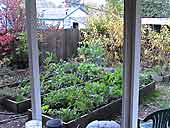 Eat the outer leaves and let the inner grow is the motto. Plants are not consumed in one picking as for commercial markets. Plants live longer, allowing abundant harvest of visual delights with zesty flavors, exuberant color and diverse shapes, sizes and textures, round, scalloped, curled and ruffled leaves. Some plants, like biennials, survive a couple years. Kales with thick contorted stalks can still produce tender leaves eaten raw or cooked. Certain broccoli varieties can live for five years! Sometimes I plant all the same seeds in a row instead of the liberated salad mix. I will leave a couple hearty, attractive or unique plants when finally harvesting the row. Planting a new row around these mavericks and rogues relieves the monotony of all in a straight military row type garden. Inter-cropping also confuses pests. Eat the outer leaves and let the inner grow is the motto. Plants are not consumed in one picking as for commercial markets. Plants live longer, allowing abundant harvest of visual delights with zesty flavors, exuberant color and diverse shapes, sizes and textures, round, scalloped, curled and ruffled leaves. Some plants, like biennials, survive a couple years. Kales with thick contorted stalks can still produce tender leaves eaten raw or cooked. Certain broccoli varieties can live for five years! Sometimes I plant all the same seeds in a row instead of the liberated salad mix. I will leave a couple hearty, attractive or unique plants when finally harvesting the row. Planting a new row around these mavericks and rogues relieves the monotony of all in a straight military row type garden. Inter-cropping also confuses pests.
The garden becomes a textured palette! Plants become more intriguing, enticing you to nurture them to creative growth. Gardening is more fun, a child in a play-room instead of a gardener doing hard labor. Because it is enjoyable, garden and gardener animate each other. Each year, gardens are unique with variations that plant spirits exhibit!
Liberated Salad is an innovative eating experiment based on the Sanskrit concept, Ahimsa (harmlessness).
Mark these three, four holidays on a calendar as annual planting days: Valentine*s Day (Feb. 14), St. Patrick*s Day (March 17), and April Fool’s Day or Earth Day (April 1 through) or Easter or Hanukah. Start seeds indoors in February and move out usually in March depending on climactic zone. Or start outdoors in March. (Most of these are not frost sensitive plants like tomatoes and squash.) I use flats or tofu containers with sterile or garden soil, adding a small amount of compost, not usually sterilized.
Seaweed spray like Maxi-crop (mixed ½-t - 1 T. teaspoon to 1 gallon water) can increase drought and frost resistance and control pests. I soak the newly planted flats with Maxi-crop and spray plants a couple times with it. Rock dust is also beneficial to plants.
Will permaculture wonderlands result? Two experiments I encourage you to do are to plant all 60-100 kinds of seeds in 2-3 beds; allow them to go to seed and re-grow. Become familiar with your local zone: then start your own Liberated Salad mix by buying or saving 50-100 kinds of seeds with a 30-215 day growing cycle, mixing them in a bowl, then packaging in l/2 – 1 teaspoon amounts in small jewelry size
plastic bags. Ideally, one would separate the 50-100 seeds and put a few in each bag, so that every bag had a few of each seed. But this is labor intensive. Consider inviting a few folks to help! Give the Liberated Salad seeds away or trade them. Store in a capped preferably dark jar in a cool dark dry location (desiccant packet in jar helps to prevents moisture).
Winter gardens are much less work than spring and summer gardens, needing little water and weeding In some years I eat for seven to eight months until mid April from planting September 1!
In the PNW one or more plantings can begin Aug. 1 through September 15. Occasional Siberian Express winters can freeze much of the garden if no protective coverings are used, but hardier edibles like chicory and kale can survive although one year the Siberian Express knocked out the Siberian kale which is a good reason to have a cloche or greenhouse for back-up. I have discovered safety nets by planting in micro- zones, i.e., on two or more sides of my house or outbuildings! The frost zones apparently can skip beds under trees or ones in certain directions from a building. Also, different height plants will survive frost better than others - more reason for successive plantings in late summer in a couple of locations.
Noting recent climate vagaries, it is possible that we may experience more temperature extremes and will need to be as cunning as Odysseus in designing food strategies for limited urban growing spaces, sometimes limited and more costly water supplies and busy schedules. We need time to share new Liberated Salad varieties with friends via potlucks and computers, don*t we?
Keep a journal or garden log of your discoveries. I sometimes video or photograph my garden over several years.
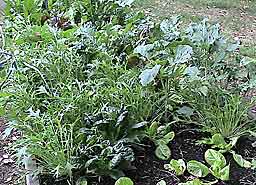 I rarely transplant a whole four-inch row from a tofu sized seedling container to the garden at the same time. A four-inch row can hold several dozen seedlings! Instead, I transplant about two-thirds of the plants from my container, so in case of weather or pest attack, some that remained in the container grow large enough to increase transplant survival rate. By leaving some in the flat, succession planting allows continual harvest. I rarely transplant a whole four-inch row from a tofu sized seedling container to the garden at the same time. A four-inch row can hold several dozen seedlings! Instead, I transplant about two-thirds of the plants from my container, so in case of weather or pest attack, some that remained in the container grow large enough to increase transplant survival rate. By leaving some in the flat, succession planting allows continual harvest.
Transplanting the critters when they are very small is ok - I often transplant when only one set of leaves appears. My transplant rate is almost 100%.
Also, in hot weather, the smaller the plant, the less likely it is that it will wilt when transplanted unless damp-off occurs.
 Raised beds are preferable because the soil warms up earlier, is drier and can be worked earlier than water logged PNW soils. Because a fair amount of compost is used in beds, the soil is rich and can be planted intensively. (In compost is the future wealth of America! I often exclaim.) For example, in a 3 or 4 by 10 foot space, 21 rows are planted 3-4 inches apart. Imagine solid beds of food for family and friends, a small measure of self-reliance. Raised beds are preferable because the soil warms up earlier, is drier and can be worked earlier than water logged PNW soils. Because a fair amount of compost is used in beds, the soil is rich and can be planted intensively. (In compost is the future wealth of America! I often exclaim.) For example, in a 3 or 4 by 10 foot space, 21 rows are planted 3-4 inches apart. Imagine solid beds of food for family and friends, a small measure of self-reliance.
The raised beds transplanted with starts germinated from seed on Aug. l through Sept. 15 produce bountiful food. Spacing the starts close together 3 or 4 inches apart - helps to prevent moisture loss and excessive weeding, a technique known as living mulch.
Grow Liberated Salad, take one giant step toward a more self-reliant healthy organic food future.
Liberated Salad is one answer to world starvation. It conserves water, fertilizer, space, gas (no need to drive to buy food when homemade gomasio on a salad tastes delicious). Gomasio has been one of the most popular additions to Liberated Salad. Homemade gomasio is far superior to the bland store-bought variety. The simple recipe: place 1-2 cups of brown un-hulled (preferably organic) sesame seeds in an ungreased iron or other skillet: lightly roast. WATCH and STIR because a dark brown color will give an off flavor; listen as seeds pop slightly, then remove from skillet. Usually I cool them before adding a big
pinch of sea salt, then grinding in a blender or processor (or use a manual shaker and grind as you use it). Gomasio is delicious in salads (RAVE reviews), soups, stir fries, cereal or as a snack.
For salad seasonings: experiment with light dustings of kelp and dulse (deep charcoal and wine red colored powdered seaweeds), brewer's yeast, cayenne, algae, olive, hemp or coconut oil, soy sauce, umeboshe plum vinegar, fresh lemon or lime juice. Liberated Salad dressing is made with these and raw organic ground sesame and sunflower seeds, garlic, miso, a splash of soy sauce and your favorite herbs. Whole grain croutons add zest and crunchiness!
Two decades ago I would rarely eat or buy kale, cabbage, mustard, turnip greens, rocket or collards. But since these succulent greens grow in my yard almost year round, I now treasure them. I usually have something with which to create a meal. Now I eat more according to what is in season and buy almost 100% organic food for items which I do not grow.
I can afford to buy organic food if I don*t waste food. Statistics show that 25+% of the food in the USA ends up in the dump. Organic food is nutritionally superior as Doctor*s Data Lab pioneer study by Bob Smith confirms. A state of the art spectrometer where 38 minerals in 8 crops were identified indicated that organically grown foods are 200-250% higher than conventional foods for 38 minerals tested: potassium, etc. The Journal of Applied Nutrition quickly accepted and printed it; doctors ordered thousands of copies to educate patients who are under-nourished.. Other recent studies indicate that those who eat organic foods especially grown in mineral rich soils do not need vitamins.
When seven protein sources are added to Liberated Salad, it is a delicious satisfying main course: e.g., sesame and sunflower seed dressing, parmesan, goat, hemp seed, tofurella or other cheeses, multi-grain croutons, raw or marinated beans, smoked or raw tofu and a few kinds of sprouts. Add a crunch to your sprouts by mixing equal parts of sprouted lentils, aduki beans and whole green peas; you can also use broccoli, sunflower, radish, buckwheat and others, lots of Vitamin C in these too!
Eat Liberated salad as a main course or side dish for 9-10 months a year. Even when the heavy frost came in mid-November, 1991, I went out at midnight to cover the raised beds for the first time. Although every leaf was hard - almost frozen - the next day there was almost no damage to my winter garden. I was pleasantly surprised that my experiment had worked. We have a lot to learn. During Siberian Express winters, beds were covered about 14 times - not every night. Use a tarp and put bricks on edges.
Amity Foundation, Eugene, OR, found in experiments in the early 80s that 3-5 times as much food can be grown in the Willamette Valley (Western Oregon) with simple protective clear plastic made into a tunnel covering or bell cloche. Their book Gardening under Cover is still in print (please support independent book stores) or available in some libraries) or read other books on cloches. Experiment with protective coverings or more permanent hotbeds, cold beds or greenhouses, free-standing or attached, to the South or East of a house, barn or outbuilding. (Do not create mildew conditions, however, if attaching a greenhouse to a house!)
Consider designing a small solar assisted structure including water or rock storage. Plastic lasts one to 20 years while fiberglass can last 20 years and glass 800+ years (European cathedrals!). Many temperate climate fertile valleys like Willamette Valley, OR, can abundantly grow early spring and winter gardens. One could make a few hundred dollars a month with a modest outlay by growing liberated salad for markets or for subscription customers. Mother Earth News has a great design for a solar pod.
Winter Gardening in the Maritime Northwest, a good reference book by Binda Colebrook, was a catalyst to my becoming more creative selecting spring and over- wintering greens and purples.
Over the last 30+ years, the 40 seeds in my seed mixture have grown to over100 varieties
- 25 kinds of lettuce and many herbs, kales, cabbages, Chinese and Japanese greens, broccolis, mustards, spinach, coriander, arugula collards, chards, a few herbs and others. With only 100, I probably miss a few gems! Send me your suggestions. I have distributed 5,000 Liberated Salad seed packs in the last 30 years to people from 150 countries. Save the seeds-eat forever! One November my sister, walked to her Pittsburgh, PA, suburban garden, and found a measure of independence - the last of her Liberated Salad planted in July. In milder Western Oregon we can pick it in most years until early April by which time new crops growing – starting it August and September.
Liberated Salad transforms into Liberated Steamed Veggies in fall and winter (using also roots grown separately). It has been as well received as Liberated Salad. Imagine a rainbow in a dish: deep purple Peruvian and yellow Finn potatoes, wine red, gold and pink and white striped beets (chiogga), purple and green ruffled kales, rocket, mustards, broccoli, turnip and beet greens, orange squash chunks, carrots, turnips, parsnips, onion and garlic, spinach, celery, cabbage and burdock.
A principal ingredient in an anti-cancer diet and two formulas, BURDOCK (edible gobo root) is gaining popularity. It is easily grown and can be a perennial. It is a central ingredient of ESSIAC tea (Canadian cancer nurse Rene Caisse*s formula from the Natives) and HOXSEY formula for cancer control (from Mexico). Its flavor is like coconut and ginseng!
Liberated Steamed vegetables satisfy the senses, delights the eye, scents the air, helps immunize the body, and could ward off cancer. Sparky mustard greens, cabbage, kale, roquette (arugula), broccoli, cauliflower, brussel sprouts and other cruciferae have pro- life, anti-cancer properties. The cream of anything soup can also be made by liquefying veggies in a blender after lightly steaming and adding non-dairy or dairy milk or other liquid, herbs and spices.
(Ahimsa blessings to Linda and Alan Kapuler, Ph.D., for giving me diverse seeds to grow so that Liberated Salad evolved to the edible rainbow bouquet it is today. Emerging from his role as the organic vegetarian non-violent food system shaman, Alan has developed into the biodiverse amino, health and nutrition scientific defender at the table.)
Dr. Kapuler sells organically grown sees through Peace Seeds, A Planetary Genome Pool Service, Plant Breeding for the Public Domain, Pacific Northwest Species Seeds; organically grown since 1973; Peace Seeds 2385 SE Thompson Corvallis, OR 97333 (Alan is a former seed research director of Seeds of Change, a national organic seed company.) PeaceSeeds.com Alan Kapuler alkapuler@gmail.com and his daughter’s company: Peace Seedlings peaceseedlings@gmail.com
Adaptive Seeds adaptiveseeds@gmail.com
Adaptive Seeds 25079 Brush Creek Rd. Sweet Home, OR 97386 541-367-1105 (email preferred)
Organic seeds including some heirlooms can also be bought from Seeds of Change www.seedsofchange.com
P.O. Box 4908 Rancho Dominguez, CA 90220; toll-free: 888.762.7333
Territorial Seeds, Cottage Grove, OR sells some organic seeds www.territorial- seed.com/organic/organic_seeds.html
P.O. Box 158 Cottage Grove, OR 97424-0061; 20 Palmer Avenue, Cottage Grove,
OR 97424 541- 942-0510
info@ territorialseed.com 541-942-9547 or toll free: 1-800-626-0866
Seed savers Exchange 3094 North Winn Road Decorah, IA 52101 www.seedsavers.org 563-382-5990 sells all open pollinated, all untreated, some organic seeds clearly identified.
(I cannot list all the wonderful seed companies – these are only a few.
(when appropriate, please credit Kathy Ging POB 11245 Eugene, OR 541-342-8461 including e-mail address: kathy@kathyging.com) |